| Figure | English Name | Category | Definition | Emphasis | Notes | DB Code |
| Aetiologia | Cause Shown | Rhetoric | When speaker renders a reason for what he thinks, says or does. | Cause | Introduced by therefore or because | AETI |
| Allegory | Allegory | Illustration | Continued comparison by representation or implication. | Points of comparison — ending or beginning sentence is the conclusion | Allegory is a broader term in Semitic languages, rather what we would call an “illustration” or “incident.” | ALEG |
| Amoebaeon | Refrain | Repetition | Repetition of the same phrase at the end of successive paragraphs. | Repeated words | Also under Repetition in DB | AMOE |
| Anabasis | Gradual Ascent | Rhetoric | An increase of sense in successive sentences. | The logic of the sentences | The concluding sentence is important | ANBS |
| Anacoluthon | Non-Sequence | Rhetoric | A breaking off the sequence of thought. | The new pronoun | Beginning of the change of pronoun is important to note | ANCL |
| Anadiplosis | Like Endings & Beginnings | Repetition | Repetition of the same word or words at the end of one sentence or clause and at the beginning of another. | The repeated words | Also under Repetition in DB | ANDP |
| Anaphora | Like-Beginnings | Repetition | The repetition of the same word at the beginning of successive clauses or sentences | The repeated word | Also under Repetition in DB | ANAP |
| Antanaclasis | Word-Clashing | Repetition | Repetition of the same word in the same sentence, with different meanings. | 1st meaning used is more important | Homonym – same word has more than one usage | ANTC |
| Anthropopatheia | Condescension | Meaning | The ascribing of human attributes to God. | The action or picture described | Hebrew name is Derech Benai Adam, “the way of the sons of man.” This figure shows God’s diversity | ANTH |
| Antimeria | Exchange of Parts of Speech | Meaning | The exchange of a noun for an adjective or adverb. | The changed word | The second noun is the adjective | ANTM |
| Antiptosis | Exchange of Cases | Meaning | One case is put for another case, the governing noun being used as the adjective instead of the noun in regimen. | The changed word | The first noun is the adjective | ANTP |
| Antithesis | Contrast | Rhetoric | A setting of one phrase in contrast with another. | The contrasting phrase | Parallel structure | ANTI |
| Antonomasia | Name Change | Meaning | Change of proper name for appellative or vice versa | What description means | Description takes place of the literal name, used often of names for Jesus Christ | ANTN |
| Apostrophe | Aside | Rhetoric | A turning aside from the direct subject matter to address others | Points to specific group | The group addressed needs to take special note | APOS |
| Asterismos | Indicating | Grammar | Employing some word which directs special attention to some particular point of subject. | Calls attention to what follows | Examples include the phrase, “truly I say to you.” | ASTR |
| Asyndeton | No-Ands | Grammar | An enumeration of things without conjunctions. | The whole unit | It is important to view the group as a whole unit and there may be climactic emphasis on last item in list | ASYN |
| Benedictio | Blessing | Rhetoric | An expression of feeling by way of Benediction or blessing. | The act of blessing and the blessing itself | The phrase may end with “Amen.” | BEND |
| Catabasis | Gradual Descent | Rhetoric | A decrease of sense in successive sentences. | The logic of the sentences | Opposite of anabasis | CATB |
| Catachresis | Incongruity | Meaning | One word changed for another only remotely connected with it. | Correct meaning. | Look for the connection | CATC |
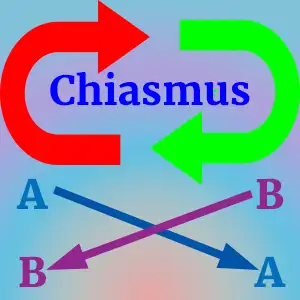
| Chiasmos | Introverted Correspondence | Rhetoric | An inverted relationship between the syntactic elements of parallel phrases | The central phrase | The middle phrase turns the point and is emphatic | CHIA |
| Climax | Gradation | Repetition | Continuous anadiplosis – repetition of endings and beginnings of one sentence or clause. | The build up of logic | Each concept repeated is important to note and consider | CLIX |
| Eironeia | Irony | Meaning | The expression of thought in a form that naturally conveys the opposite | The opposite meaning | Can be sarcastic, but more often is only obviously the opposite. See also antiphrasis | EIRO |
| Ellipsis | Omission | Rhetoric | Words omitted from a sentence or phrase that are necessary to complete the grammar, but not the sense | The omitted word or concept | There are many kinds of ellipsis | ELPS |
| Epanadiplosis | Encircling | Repetition | Repetition of the same word or words at the beginning and end of a sentence. | Repeated word(s) | Consider the sentences in between as a unit of thought | EPAD |
| Epanados | Inversion | Repetition | Repetition of different words in a sentence, in an inverse order (but same sense) | Repeated words | Contributes to understanding of the structure of a passage | EPND |
| Epanorthosis | Correction | Repetition | Recalling of ivhat has been said, in order to correct it as by an afterthought | The correction | Look for the stronger statement | EPOR |
| Epizeuxis | Duplication | Repetition | Repetition of the same word in immediate sucession. | Repeated word | Effect is to establish the word duplicated, very solemn meaning, often used in addressing people | EPZX |
| Erotesis | Interrogative | Rhetoric | The asking of questions without waiting for the answer. | Answer | The meaning must be gleaned by putting the question into a statement; there are various kinds | EROT |
| Euphemismos | Ephemism | Meaning | Change of what is unpleasant for pleasant | The reality of what is meant | Emphasis is on the unpleasant concept | EUPH |
| Hendiadys | Two for One | Meaning | Two words used, but one thing meant. | The combination of concepts | The one thing meant is greater than the individual meanings of the two words | HDYS |
| Hendiatris | Three for One | Meaning | Three words used, one thing meant | The combination of concepts | The one thing meant is greater than the individual meanings of the three words | HDTR |
| Hypallage | Interchange | Meaning | An interchange of construction whereby a word is grammatically united with another | The noun in regimen | In a genitive phrase the first noun is interchanged as an adjective | HYPA |
| Hyperbole | Exaggeration | Meaning | When more is said than is literally meant. | The literal meaning | More is said in order to heighten the sense | HYPB |
| Hypocatastasis | Implication | Illustration | A declaration that implies the resemblance or representation, comparison by implication | What is compared | There is an implication of similar qualities. Can be a verb or noun. In modern grammar it is called a metaphor | HYPO |
| Interjectio | Interjection | Interjection | A parenthetic addition complete in itself, thrown in between, an exclamation | What follows the exclamation | This is a broad figure, covering many kinds of interjections and exclamations | INTJ |
| Meiosis | Belittling | Rhetoric | A belittling of something in order to magnify something else. | The true meaning | Compare to tapeinosis | MEIO |
| Merismos | Distribution | Meaning | An enumeration of the parts of a whole that has been mentioned. | The whole | Example: “morning and evening” means the whole day. | MERI |
| Metalepsis | Double Metonymy | Meaning | Two metonymies, one contained in the other, but only one expressed | The meaning underneath | There are at least two steps to discover the meaning | MTLP |
| Metaphor | Representation | Illustration | A declaration that one thing is (or represents) another, or comparison by representation | Quality that is compared | Usually has form of the verb “to be” | MEPH |
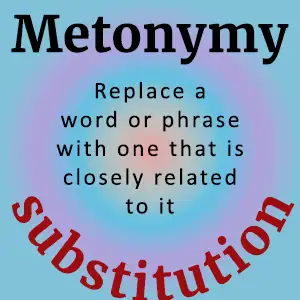
| Metonymy | Change of Noun | Meaning | The change of one noun for another related noun | The related noun | There are several categories. | MTNY |
| Oxymoron | Wise-Folly | Rhetoric | A wise saying that seems foolish | The wisdom or lesson implied | Some proverbs utilize this figure | OXYM |
| Parabola | Parable | Illustration | Comparison by continued resemblance. | Points of comparison | Can be an extended simile with more than one point of comparison. Parable is a broader term in Semitic languages | PARB |
| Paradiastole | Neither-Nor | Grammar | Repetition of the disjunctives: neither, nor, either, or | Words in between | Consider each noun or phrase carefully | PARD |
| Paramegnon | Derivation | Repetition | Repetition of words derived from same root: similar in sound but different in meaning | The build up of concept | Usually different nouns or verbs formed from same root but which have distinct meanings of their own | PARM |
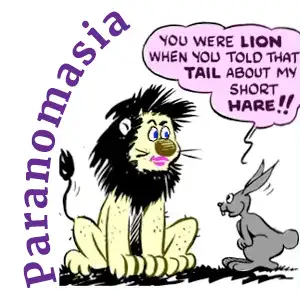
| Paranomasia | Rhyming Words | Repetition | Repetition of words similar in sound, but not in sense or origin. | The concepts that rhyme | Each concept is important | PARN |
| Parembole | Insertion | Rhetoric | A parenthetic addition complete in itself – a digression. | The parenthesis as a unit | True parentheses where the context is not needed or required to be understood | PARL |
| Parenthesis | Parenthesis | Rhetoric | A parenthetic addition complete in itself, but needs context to be understood | The following sentence | This is the true figure of parenthesis used as an explanation or description. | PART |
| Paroemia | Proverb | Rhetoric | A saying, a trite expression, common remark, maxim | The moral lesson implied | These are culturally related and it is important to understand the manners or customs behind the saying | PARE |
| Paromoesis | Assimilation | Repetition | Repetition of inflections similar in sound | Words with repeated inflections | Also under Repetition in DB | PARO |
| Periphrasis | Circumlocution | Meaning | When a description is used instead of the name. | The action | Example: “lifted up his voice.” | PERH |
| Pleonasm | Redundancy | Meaning | Where what is said is immediately after put in another or opposite way to make it impossible for the sense to be missed. | Repeated concept | Second word or phrase is stronger | PLEO |
| Polyptoton | Many Inflections | Repetition | Repetition of the same noun or verb in different conjugations or inflections. | The root verb | Can be verb with related noun/adjective. Common in Semitic languages. | PLYP |
| Polysyndeton | Many-Ands | Grammar | The repetition of the word “and” at the beginning of successive clauses or sentences. | Each connected noun or phrase | Consider each word connected with “and” carefully | PLYS |
| Prosopopoeia | Personification | Illustration | Things or ideas represented as persons. | The action | Human characteristics or actions are given to inanimate objects or abstract ideas. | PRSP |
| Repetitio | Repetition | Repetition | Repetition of the same word or words irregularly in the same passage. | Ties the passage together | The repeated word is emphasized but often to set the structural pattern. Many different kinds | REPT |
| Simile | Resemblance | Illustration | A declaration that one thing resembles another, comparison by resemblance. | Quality that is compared | Uses “like” or “as” in comparison. | SIML |
| Synathreosmos | Enumeration | Rhetoric | The enumeration of the parts of a wiole which has not been mentioned | Each concept or phrase | A number of different words are united under a common theme | SYNA |
| Synecdoche | Transfer (or Part for Whole) | Meaning | The exchange of one idea for another associated idea. | The implied idea | This figure is often used of time. | SYNC |
| Synonymia | Synonym | Meaning | Repetition of words different in sound and origin, but similar in meaning | The repeated concept | Common in English and Western languages. | SYNO |
| Tapeinosis | Demeaning | Rhetoric | A lessening of a thing in order to increase it. | The superlative meaning | Differs from meiosis – the word(s) emphasized are the same | TAPE |
| Zeugma | Unequal Yoke | Rhetoric | When one verb is yoked to two subjects, while grammatically a second verb is required. | First verb | There are four forms in Greek | ZEUG |