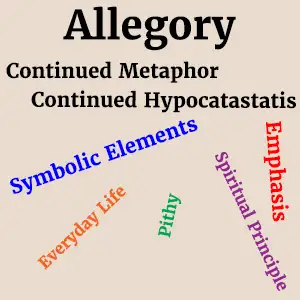
Normally, the definition of allegory is similar to the following from “Silva Rhetoricae” (rhetoric.byu.edu): “A sustained metaphor continued through whole sentences or even through a whole discourse.” I believe that in terms of study of the Aramaic New Testament, this definition is too narrow. Especially in the Gospels, Jesus used examples which were not a whole story where every element was compared to something else. They were pithy short illustrations, usually from everyday life, that communicated a spiritual principle. Allegory involves the use of symbolic characters, events, or settings to convey deeper meanings or abstract concepts. Instead of presenting ideas directly, an allegory uses a narrative or story to represent and communicate underlying truths or moral lessons.
There are several examples in the Sermon on the Mount:
Matthew 6:19–20 APNT:
You should not place for yourself treasures on earth, where moth and rust corrupt and where thieves break in and steal.
But place for yourself treasures in heaven, where neither moth nor rust corrupt and where thieves do not break in and do not steal.
For where your treasure is, there is also your heart.
This is a comparison of having a “treasure room” in a house, which was a glorified closet and would be subject to be corrupted by insects, weather, such as rain leaking through the roof, or thieves breaking a hole in the mud walls. It was a common picture of a storage room in a home. The entire passage teaches the lesson that spiritual treasures are much more important than earthly wealth.
The emphasis in an allegory is on the comparative elements, but also on the moral of the illustration. Normally, the concluding sentence has the emphasis: “for where your treasure is, there is also your heart.” In every allegory, the student should seek for this concluding remark or the lesson behind the illustration.
One well-known example of allegory in the Bible is the Parable of the Good Samaritan (Luke 10:25–37). In this story, Jesus uses the characters of a man who was robbed and beaten, a priest, a Levite, and a Samaritan to convey the broader message of showing mercy and compassion to others, regardless of their social or ethnic backgrounds. The characters and their actions symbolize different attitudes and behaviors, allowing the listeners to grasp the deeper moral lessons behind the story.
Another example is the allegorical representation of the vine and the branches found in John 15:1–8. In this passage, Jesus compares himself to a vine and his followers to branches. The imagery of the vine and branches symbolizes the intimate connection between Jesus and his disciples, emphasizing the importance of remaining connected to him to bear spiritual fruit.
There are two types of allegories: a continued metaphor and a continued hypocatastasis. Bullinger does a great job in explaining the difference and the Master Spreadsheet distinguishes these two types. Here is the quotation from Figures of Speech in the Bible:
Few figures have been the subject of greater controversy than Allegory; or, have been more variously defined. One class of Rhetoricians declare that it is a continued metaphor: and another class declare that it is not. But, as is often the case under such circumstances, neither is quite correct, because both have a part of the truth and put it for the whole. Neither of the contending parties takes into consideration the existence of Hypocatastasis. And this fact accounts for the confusion, not only with regard to Allegory, but also with regard to Metaphor.
All three figures are based on comparison.
- Simile is comparison by resemblance;
- Metaphor is comparison by representation;
- Hypocatastasis is comparison by implication.
In the first the comparison is stated; in the second it is substituted; in the third it is implied.
Thus Allegory is a continuation of the latter two, Metaphor or Hypocatastasis; while the Parable[1] is a continuation of the Simile.
This definition clears the whole ground, and explains the whole of the difficulties, and reconciles the different schools.
The Allegory, therefore, is of two kinds; one in which it is continued Metaphor (as in Psalm 23), where the two things are both mentioned (Jehovah, and the Shepherd’s care), and what is asserted belongs to the principal object; the other, in which it is continued Hypocatastasis (Psalm 80:8–15), where only one thing is mentioned (the vine), and what is asserted belongs properly to the Secondary object; viz., to Israel. Israel whom it really refers, is not mentioned, but only implied.
[1] Which see.